Every company that gets serious about AI reaches the same fork: build an in-house team, or buy the capability by partnering with a provider? Build vs. buy AI is the choice between running your own AI team and bringing in an outside partner. It looks like a budget question, but the price tag is the smallest part of the cost. The bigger numbers hide in time to value, the odds of success, and what you give up while your team learns.
Key takeaways
- •An in-house AI team costs far more than salaries once you add recruiting, tooling, ramp, and churn, and takes 12 to 18 months to ship.
- •Partnering reaches results faster on a phased budget, suiting most companies using AI to improve operations, not to sell it.
- •Build when AI is your core product or your data must stay in-house. Buy when you need speed, budget control, or proven compliance.
- •A hybrid path, partner first and build over time, often beats choosing one outright.
The real question behind build vs. buy AI
Framing this only as "hire or outsource" is too narrow. A clearer decision weighs four things at once:
- Total cost of ownership: salaries plus tooling, infrastructure, recruiting, and maintenance over two to three years.
- Time to value: how long until the work produces a measurable result.
- Execution risk: the odds it reaches production and delivers a return.
- Opportunity cost: what you lose while your team ramps instead of shipping.
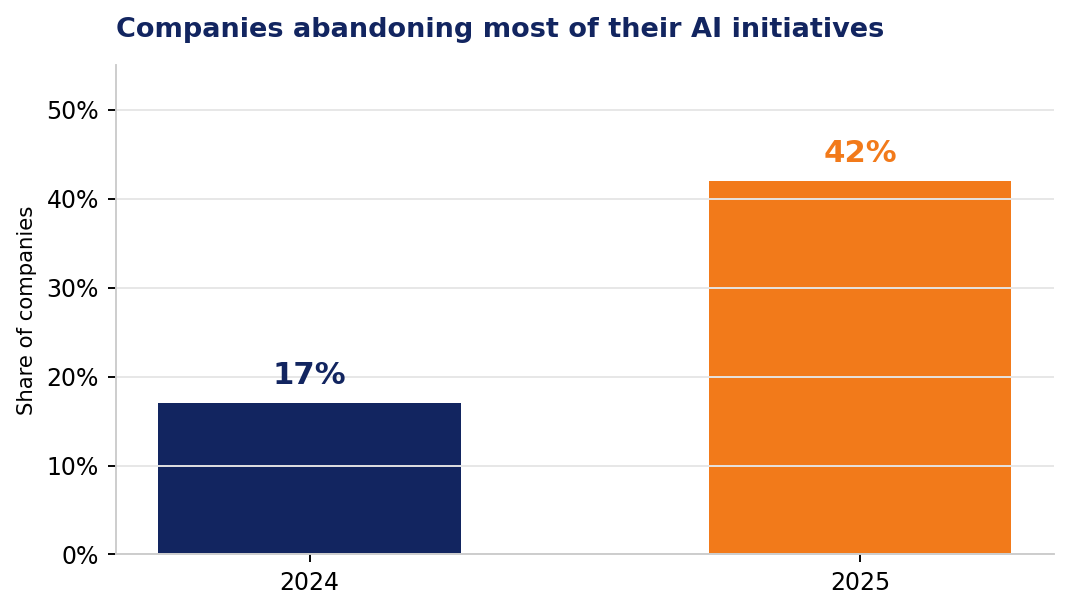
That last point is where most comparisons fall apart. RAND finds more than 80 percent of AI projects fail, about twice the rate of comparable non-AI IT work; a 2025 MIT study found only about 5 percent of integrated enterprise generative AI pilots produced measurable financial impact; and S&P Global reported the share of companies abandoning most AI initiatives more than doubled in a year, from 17 percent in 2024 to 42 percent in 2025. Each measures something different, but the direction is the same; the cause is rarely the model but messy data, weak integration, and unclear success criteria.
What building an in-house AI team really costs
Building gives you control and ownership, plus costs that rarely show up in the first budget.
The talent bill and the AI talent shortage
A working AI team is not one hire: you need a machine learning engineer, a data engineer, and an MLOps owner. The AI talent shortage makes this harder than a normal hire, with roles sitting open for months while salaries climb. US machine learning engineer base salaries run around $130,000 to $190,000, and total comp for senior engineers often passes $200,000. Add everything around those salaries, and a lean three-person team can easily reach $600,000 or more per year before it ships a single result.
Time to value
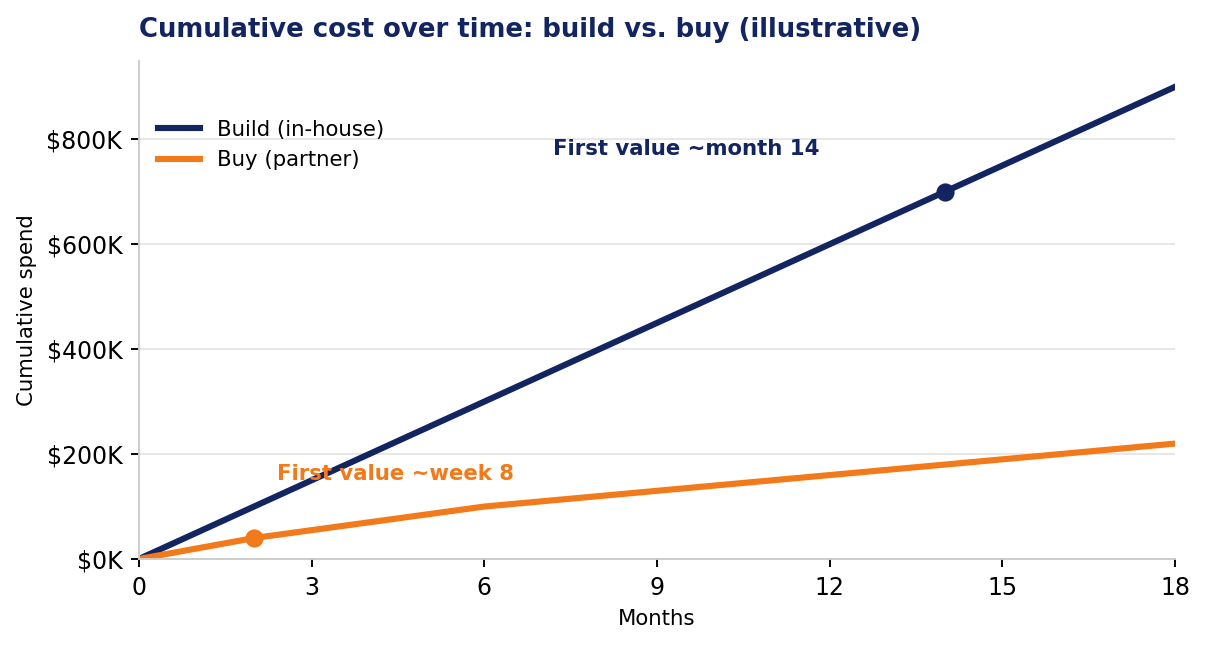
This is the cost that stings most. Beyond pay, you carry recruiting, ramp, and churn risk. A first production system commonly takes 12 to 18 months, and Gartner reports an average prototype-to-production cycle of about eight months even for projects that survive: a year or more of payroll before any return arrives.
What hiring an AI development partner costs
Buying means working with a partner that already has the team, tooling, and experience. Where building commits you to a large fixed payroll, a partner engagement is scoped to a project and budget: a first build is often in the tens of thousands, not the hundreds, and you expand only once it proves out.
Predictable cost, faster value
You scope work to your budget and pay against milestones, so spending is easy to forecast and you scale only what works. And the partner's existing, multi-skilled team and reusable patterns move you from problem to working solution in weeks, not a year.
The honest trade-offs
Buying is not free of downside. You have less day-to-day control and a vendor to manage, and a poor partner can leave you with a system you cannot maintain. Choose one that builds in knowledge transfer and hands you documentation and ownership, not a black box.
Security, data, and IP ownership
Ownership cuts both ways. Building keeps everything in-house: data never leaves and the models and code are yours by default, a real reason to build when your data is sensitive or your model is the moat. Partnering need not give that up if you set it up right. A serious partner works inside your security boundary rather than exporting data, assigns all IP to you by contract, and meets the frameworks your industry requires, such as SOC 2, HIPAA, ISO 27001, and GDPR (Connexr builds with RSA Tech Group's compliance behind it). Ask where your data lives, who owns the code and models, and whether they meet your needs.
Build vs. buy AI, side by side
Build vs. Buy AI, at a glance
| Dimension | Build (in-house) | Buy (partner) |
|---|---|---|
| Upfront cost | High: salaries, infrastructure, tooling | Lower, phased to budget |
| Time to value | 12 to 18 months or more | Weeks to a few months |
| Talent risk | High: shortage, hiring delays, churn | Carried by the partner |
| IP and data | Stays fully in-house | Yours by contract; confirm terms |
| Scalability | Limited by headcount | Scales with the engagement |
| Control | Full internal control | Shared, needs vendor management |
| Ongoing maintenance | Your team owns it | Included or managed |
| Best fit | AI is your core product | AI improves a non-core process |
Connexr works within the RSA Tech Group ecosystem, which has delivered end-to-end AI and data migration and implementation projects for organizations ranging from a leading national insurer to national retailers and US staffing and data services firms, the kind of scoped, partner-led work this article describes.
When building in-house makes sense
Partnering is not always right, and any provider who says otherwise is selling. Building gives you advantages a partner cannot replicate, and it is the better call when:
- AI is your core product, and a proprietary model is your edge, so it belongs in-house where you keep the IP.
- You have enough work to keep a team busy, where per-project cost can fall below a partner's over time.
- You want institutional knowledge to compound across projects.
- You need maximum control over data and security, with nothing leaving your environment.
If two or three describe you, building is worth the cost and wait, accepting slower time to value and full exposure to the talent shortage.
When partnering wins
For many businesses, especially SMBs and mid-market companies using AI to improve operations rather than sell it, buying delivers value sooner. Partnering tends to win when:
- You need a return this quarter, not next year.
- Budget discipline matters and you want results scoped to what you can spend.
- AI supports the business but is not the business, improving a process like claims handling or forecasting.
- You work in a regulated industry (healthcare, fintech, insurance) where a compliant build must be right the first time.
This is the space Connexr is built for: customized AI scoped to your budget and measured against outcomes like lower costs, faster time to market, and ROI.
The hybrid path: partner now, build later
The build-or-buy framing hides a third option that often beats both: start with a partner, then build capability over time. The partner gets you to production fast and transfers knowledge and ownership, so your team takes on more without lock-in.
A simple way to decide
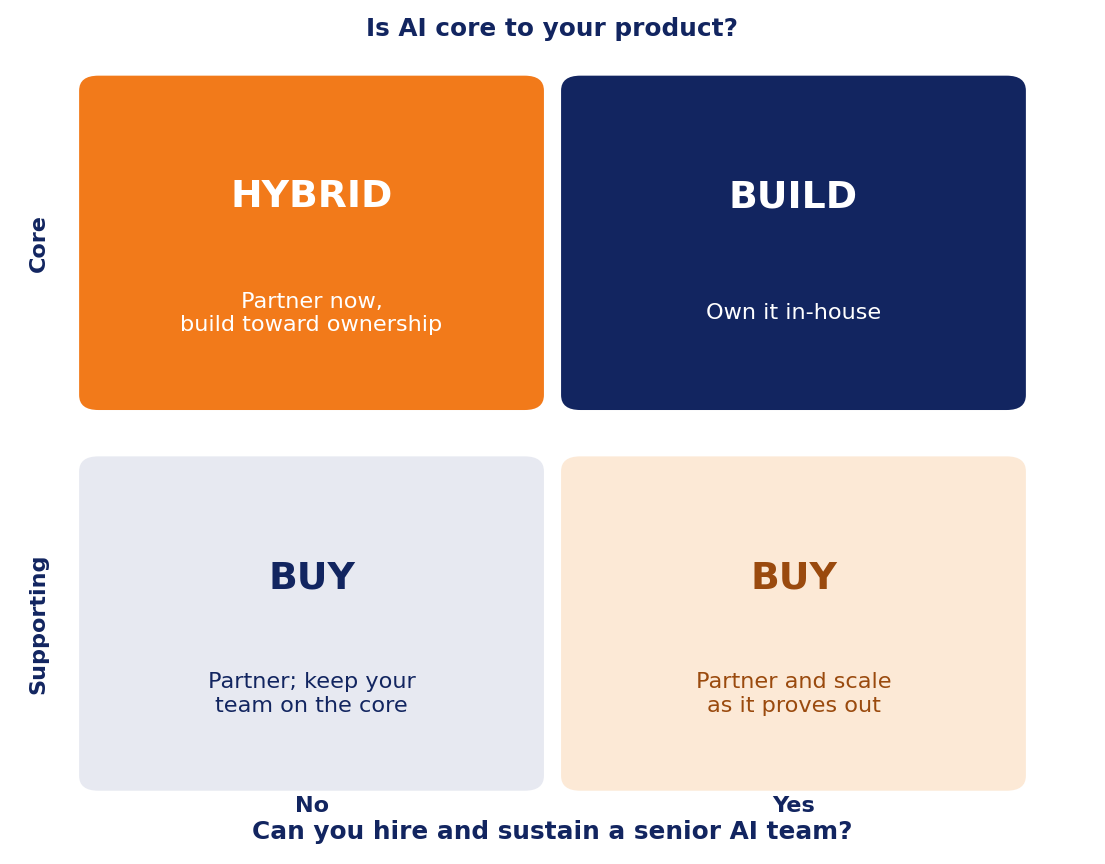
Strip away the noise and two questions settle it for most companies: is AI core to your product, and can you realistically hire and sustain a senior AI team? Plot your answer on the matrix below. Most companies land outside the build quadrant, which is exactly why partnering or a hybrid path is the higher-return move so often.
The bottom line
The build vs. buy AI decision is not about which option looks cheaper on paper. It comes down to speed, risk, control, and whether AI is core to what you sell. Build when AI is your product, your IP must stay internal, and you have the scale for a team. For everyone else, partnering reaches results faster and with far less risk.
The most expensive option is rarely build or buy. It is spending a year on the wrong one. Start with a short AI readiness assessment to find the fastest path to a return, then scope a first project.
Find your fastest path to AI ROI
Start with a complimentary AI Readiness Assessment with Connexr and receive:
- A build, buy, or hybrid recommendation for your situation
- Your highest-value ROI opportunities, prioritized
- A clear scope, timeline, and budget for a first project
- An honest view of where to invest and where to wait
No obligation and no jargon. Just the fastest route to a return, and what it will take to get there.
Frequently Asked Questions
Connexr is a division of RSA Tech Group | connexr.com | SOC 2 | HIPAA | ISO/IEC 27001:2022 | GDPR Compliant