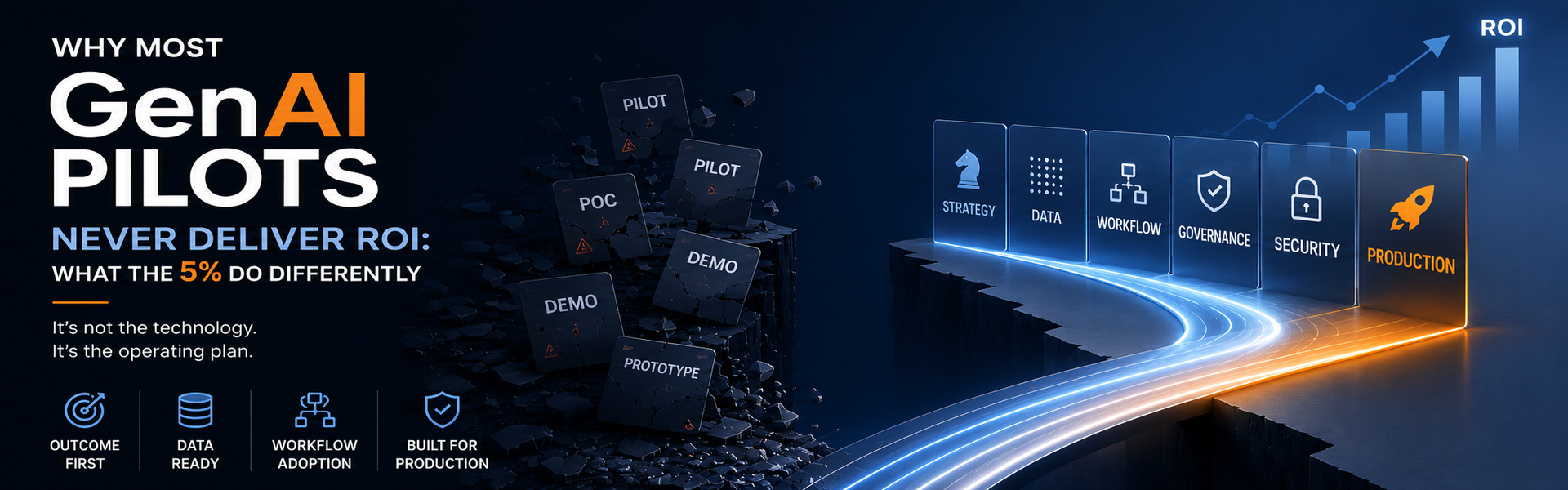
Your board approved the budget. Your team built an impressive pilot. The demo earned a round of applause. Then a few quarters passed, and the P&L looked exactly the same as before. If that story feels familiar, you are not the exception. You are the rule.
In 2025, MIT's Project NANDA published a widely cited study, The GenAI Divide: State of AI in Business 2025. Its central finding was stark: despite an estimated $30 to $40 billion in enterprise spending, roughly 95% of organizations saw no measurable return on their generative AI investments. Only about 5% of pilots were extracting real, documented value. The study draws on more than 300 disclosed AI initiatives, 52 executive interviews, and 153 leadership surveys, so it is best read as a directionally strong snapshot of where enterprise AI stands.
The companies generating ROI from AI are not using dramatically better models. They are executing dramatically better operating plans. Most organizations do not have an AI problem. They have a business-value problem.
That distinction is the whole game. The operating plan takes shape long before the first line of code, and most teams skip the parts that matter in the rush to ship something impressive. Here is why that gap opens up, and what the 5% do to close it.
The failure is operational, not technical
The instinct in most boardrooms is to assume the gap is technical. The model was not good enough. The vendor overpromised. The use case was too ambitious. The evidence points somewhere far less glamorous.
Gartner found that generative AI projects are abandoned after the proof-of-concept stage for four recurring reasons: poor data quality, inadequate risk controls, escalating costs, and unclear business value. Not one of those is about the intelligence of the model. Every one is a leadership and operating decision.
Pilots do not die in the lab. They die in the gap between a working demo and a reliable business asset. The industry calls that gap pilot purgatory, and projects get stuck there not because the technology cannot work, but because no one set up the conditions for it to work at scale.
The pattern that separates the 5%
One pattern in the MIT data stands out. Organizations that combined internal teams with experienced implementation partners consistently outperformed those attempting AI transformation entirely on their own. The ones getting results were not necessarily building alone or buying off the shelf. They were pairing internal teams, who understand the business, with partners who bring execution experience. This does not mean in-house capability has no place. Strong internal teams are essential. The practical takeaway is that the combination tends to outperform either approach on its own.
Picture a mid-market insurer. (This is an illustrative composite, not a specific client.) The innovation team builds a tool that drafts claim summaries, and it is genuinely impressive in the demo, running on two hundred clean sample claims. Then it meets production. Real claims live across three systems in inconsistent formats, the model starts producing confident but wrong summaries, no single person owns the data integration, and compliance raises questions no one budgeted time to answer. Seven months and a growing invoice later, the project is shelved. The technology was never the problem. The absence of an owner for the unglamorous parts was.
Building entirely in-house can feel like the safer path, but it often means your team is learning expensive lessons on your own budget and timeline. Pairing internal knowledge with a partner who has already navigated those lessons, especially in regulated industries where a single compliance or security miss carries real cost, is what the research associates with actually reaching production.
What the 5% do differently
That pattern sets the foundation. These four operating disciplines are what close the gap.
They define the business outcome before they write code
The fastest way to land in the 95% is to start with "let us try AI on this." Curiosity is not a strategy. Winners start with a number: cut claims-processing time by 40%, reduce cost per support ticket by a set amount, shorten the sales cycle by a measurable margin. Define success before you build, and you know exactly when a pilot has earned the right to scale. Pilots without a finish line wander until the budget runs out.
They fix the data foundation first
This is the quiet killer from the insurer story. A vendor demo runs on curated, clean data. Your production environment is messier, more fragmented, and far larger. The 5% invest in data readiness before they invest in the model: connecting silos, cleaning inputs, and making sure the system can reach accurate, current information. It is less exciting than a flashy prototype, and it is the highest-leverage move most organizations can make to change their odds.
They build for the workflow, not the wow
Adoption is where pilots quietly expire. A tool that impresses leadership but does not fit how people work on Monday morning returns nothing. MIT found that successful deployments empowered frontline teams and line managers to drive adoption, rather than confining AI to a central lab that hands down experiments. Embed the solution where the work actually happens, and measure usage as closely as you measure accuracy. An unused model is an expense, not an asset.
They design for production from day one
A pilot that was never built to scale will never scale. Gartner found that only about 48% of AI projects reach production at all, and the average prototype-to-production journey takes around eight months. The 5% compress that timeline because risk controls, monitoring, retraining, security, and compliance are part of the original blueprint, not bolted on after the demo succeeds. They also phase the spend: scope tightly, prove value in a contained phase, and scale only what works. Budget follows evidence, not optimism, so the project stays defensible at every board meeting.
From pilot to production: the common thread
One theme connects all of this. The 5% own the entire journey. They do not treat the pilot as a finish line, and they do not drop the baton when the work gets hard. Strategy, data, build, adoption, deployment, governance, and ongoing optimization are treated as one continuous effort, not a relay race between disconnected teams.
That is the gap most organizations cannot close on their own. They have the ambition and the budget. What they lack is a partner who carries the work from the first conversation through to a production system that keeps earning its keep.
The question is not whether your organization can deploy AI. It is whether it can consistently move successful pilots into production.
How ConnexR closes the gap
ConnexR exists for exactly this. As the AI solutions arm of RSA Tech Group, we own the full path to production: discovery, strategy, design, build, deployment, and ongoing managed AI services. We scope to your budget and expand as the ROI proves out, we measure every engagement against an outcome you define up front, and we engineer around your industry and your data rather than a template. Because we work inside the RSA Tech ecosystem, your project inherits enterprise-grade cloud, security, and compliance from day one, including SOC 2, HIPAA, ISO 27001, and GDPR alignment.
The 5% are not luckier or better funded than everyone else. They are simply better organized around the decisions that determine the outcome, starting with who owns the work. With the right partner, that discipline is available to any business, at any budget.
Ready to join the 5%?
Most AI budgets are spent proving what does not work. Yours does not have to be.
Book a complimentary AI Readiness Assessment with ConnexR and receive:
- An AI maturity evaluation of your organization
- Your highest-value ROI opportunities, prioritized
- A clear pilot-to-production roadmap
- Budget and timeline recommendations
No obligation and no jargon. Just a practical view of where AI can move the needle for your business, and what it will take to get there.
Frequently Asked Questions
Connexr is a division of RSA Tech Group | connexr.com | SOC 2 | HIPAA | ISO/IEC 27001:2022 | GDPR Compliant